
Illusion Called Ownership
- Video
- Audio
- Article
- Question and Answers
No Video Available
No Audio Available
Illusion Called Ownership
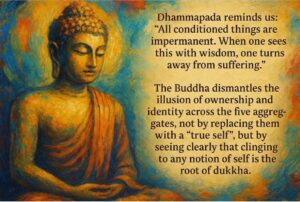
If the Ego is realized as nothing but a conditioning ( external effect ), ( right since birth until now ), and also if it is realized that all conditionings are impermanent, then permanence gets realized.
Buddha’s message is clear in this image.
Anything that came to you from outside has conditioned, influenced, and changed you.
It cannot be you.
When you claim ownership of them and then use them to create a self ( Ego ), suffering will be on your lap.
(I am such-and-such person’s son, father, friend, etc. (relatives are outside of you).)
I am a Jain, Hindu, etc ( based on religions which came from outside )
I am rich, poor, etc. (based on external wealth).
When you carefully dissect this, use the method of neti neti (not this, not this, etc.), you start your inner journey.
But the most significant difference between other religions and Buddha’s philosophy is that others accept Atma (soul) as the true self, while Buddha does not recognize the existence of Atma at all (Anatta).
So, he is one step ahead of the rest, because when one transcends their perceived self (Ego), they feel they are losing all their supports and need to hang onto something.
So they drop their Ego, but the Ego remains, subtly, and that’s why they say “Aham Brahmasmi” (I am the Brahma).
They detach from their old self and attach to the “true self”.
Buddha says – that is also clinging. ( as he says in the second paragraph )
And that’s why Buddha does not accept the existence of atma.
According to him, in the end, nothing remains – no Atma and no “I”, nothing.
Nothing to cling to.
And that’s why he coined the word Nirvana (the lamp is shut off).
That’s why he never answered any questions regarding Atma.
He said it is the first truth; if I talk about it, it will become the second truth.
It cannot be described, only experienced.
No Question and Answers Available